
Category

Publications

21st.BIO as a key enabler of large-scale biomanufacturing

By Publications

The question isn’t if the science works – but how fast it can scale.

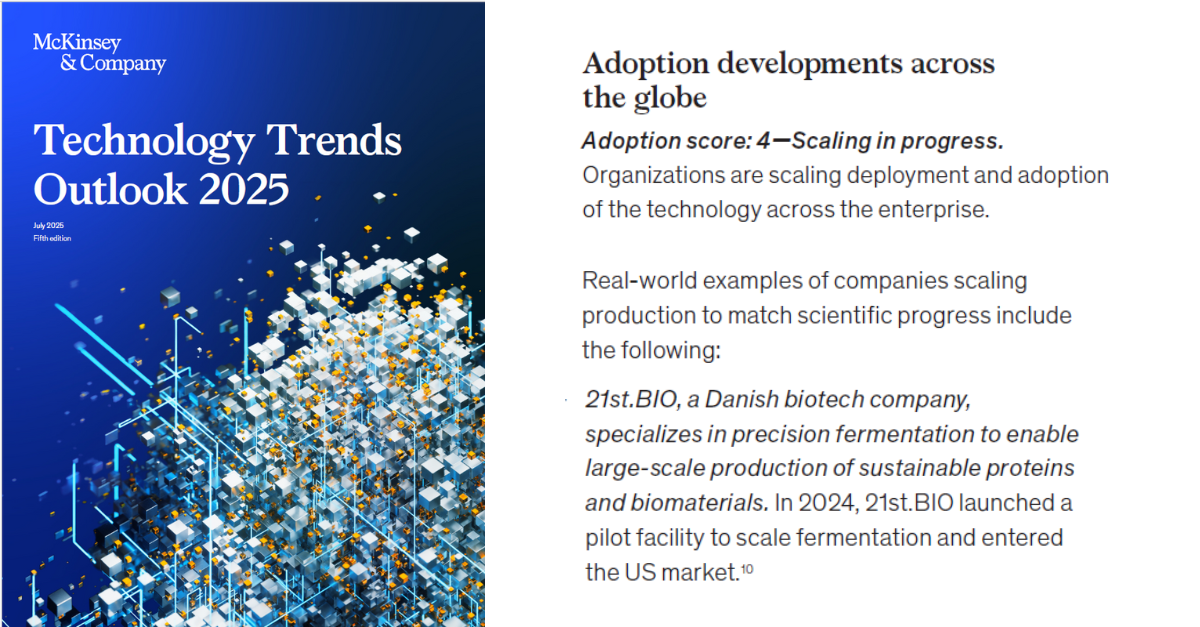
We’re proud to see McKinsey’s Technology Trends Outlook 2025 naming 21st.BIO among the companies shaping the future with groundbreaking technology.

This year’s report highlights 13 frontier technologies transforming global industries – from artificial intelligence and next-generation computing to space tech, robotics, energy and sustainability, and bioengineering.

That’s where we come in.

McKinsey highlights 21st.BIO as a key enabler of large-scale biomanufacturing: “Manufacturing capacity is beginning to scale to match scientific progress. The bioengineering industry is expanding production capacity by installing large-scale infrastructure, such as 2,000-liter bioreactors, to support growing demand and enable broader clinical translation.”

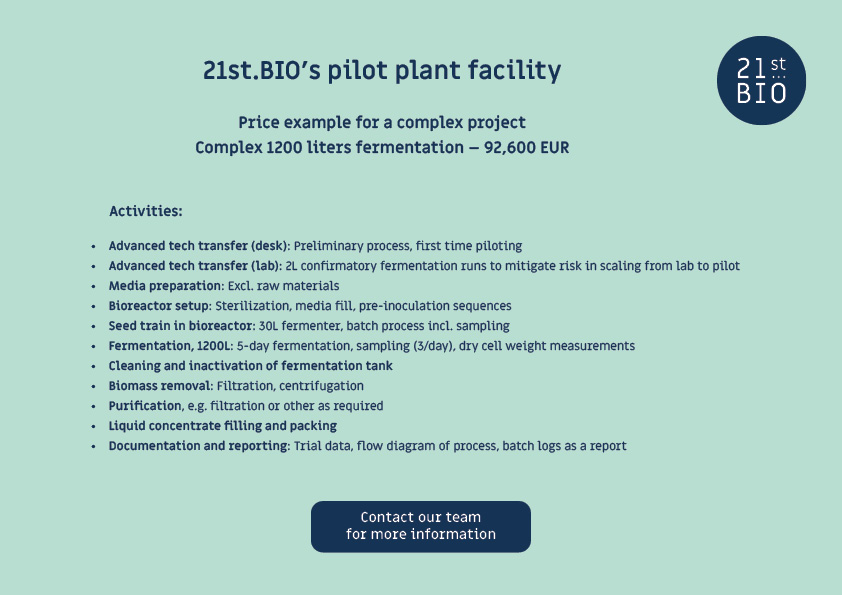
At 21st.BIO, we’re proud to be part of this transformation. Our precision fermentation platform and pilot facility help companies take proteins and biomaterials from lab breakthroughs to industrial-scale production – and we’re going further.

Even with optimal strains and processes, fermentation capacity remains a rate limiting factor. We see scaling rapidly moving from thousands to millions of liters in industrial production to meet global demand.

That’s why we’re working with partners worldwide to establish local and regional fermentation, providing technology which enables attractive business cases. Lack of capacity shouldn’t hold back innovation and the benefits thereof.

The future of biotechnology is being built today – and scaling is a key factor.

New publication in Annual Reviews of Food Science and Technology

By Dairy proteins, Publications

We are thrilled to announce the publication of our latest scientific paper, “The Next Food Revolution Is Here: Recombinant Microbial Production of Milk and Egg Proteins by Precision Fermentation” in Annual Reviews of Food Science and Technology.


This work is authored by our brilliant colleagues José Arnau, R&D Director, and Morten Bjørn Nielsen, Industrial PhD student.

In a world where food production must be drastically increased to meet the demands of a growing population and simultaneously made sustainable to respect and preserve our planet, precision fermentation offers a revolutionary solution.

Using microbes to produce animal-identical proteins, precision fermentation is set to transform our food systems. This technology is incredibly efficient regarding land, water, and feedstock use, and is expected to make food production sustainable and to result in more local production of designed food products, such as dairy or egg proteins.

But for this food revolution to happen, the technology needs to scale, with production titers reaching 50 g/L and above. This requirement makes strain engineering, process optimization and scale-up critical success factors. And that’s why we at 21st.BIO make it our mission to develop the best production strains and fermentation processes, continuously optimizing every single step, and supporting our customers to upscale towards industrial production. We do it so you don’t have to.

Our top-performing strains are already working with dairy and egg proteins. Explore our development programs, and contact us for more information.

We strongly recommend this read to better understand precision fermentation and its potential. Whether you’re a seasoned expert or just curious, this paper has valuable insights for everyone.

New industry report by the Boston Consulting Group and Synonym

By Public affairs, Publications

“How to get precision fermentation biomanufacturing to cost-efficiency?”

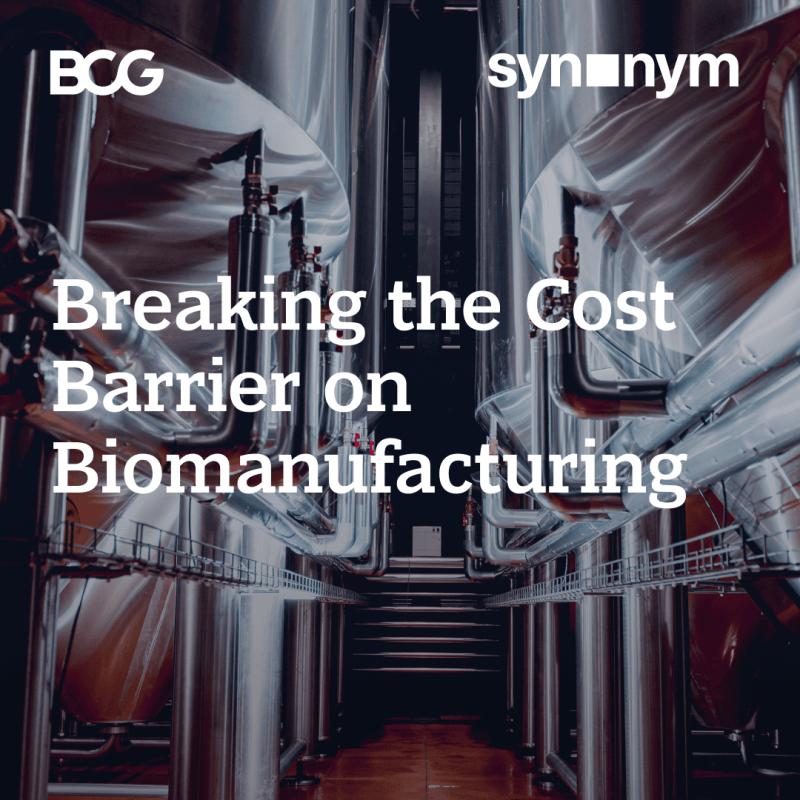
That’s precisely the question Boston Consulting Group‘s latest report, ‘Breaking the cost barrier in Biomanufacturing’, intends to answer. The report was written in collaboration with Synonym, with contributions from our co-founder and CSO, Per Falholt.


Biosolutions hold immense promise to revolutionize the food, specialty chemicals, and biomaterials industries. With increasing global demand for sustainability and emissions reduction, there is a pressing need for economically viable biomanufacturing at scale.

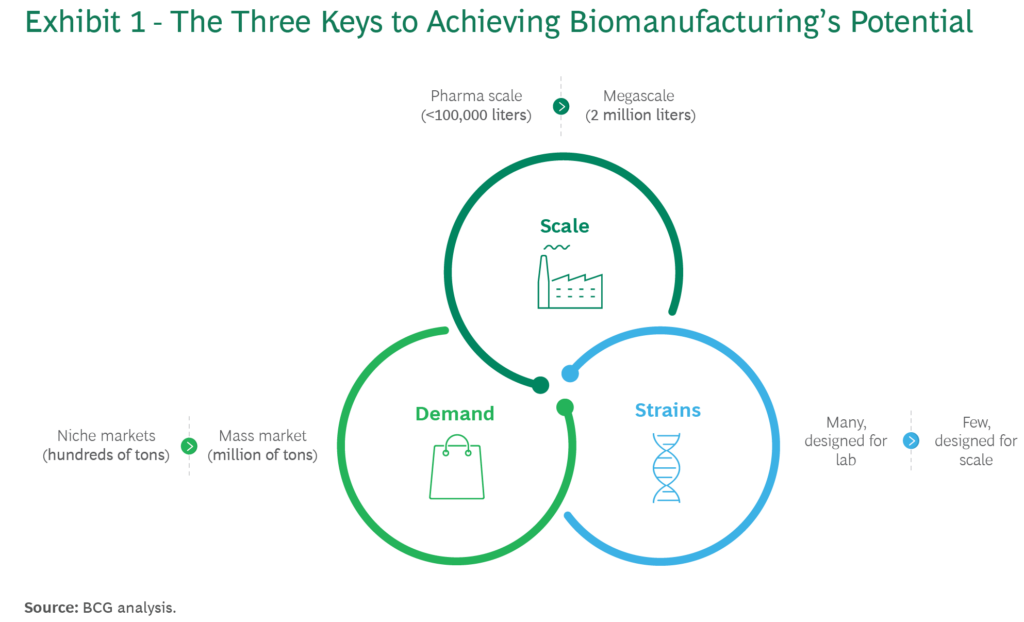
But how do we get there? The solutions are trifold:

▶ optimization of large-scale facilities,
▶ production technology (strains and processes) designed for industrial scale,
▶ collaborative efforts among stakeholders — from corporate customers to policymakers — to drive investment and infrastructure development.

According to the report, all these efforts would pave the way for a $200 billion market by 2040.

The report also insists on the importance of developing production strains designed for large scale.


At 21st.BIO, we are proud to say that our strains are designed for industrial scale. With our technology platform, the industry can move forward to the next stage.

Developing microbial strains designed for scale is a tremendous challenge. While many strains might do very well in lab conditions, upscaling production to industrial scale remains an obstacle for most companies.

In the report, BCG estimates that producing strains optimized for large-scale manufacturing in optimized large-scale biofoundries could bring costs down by 90%.

Our company was founded with one simple mission: to make precision fermentation technology accessible to as many companies as possible, so they can successfully take their product to market at a competitive price.

Secret Link