

New publication alert 🚨
What if the next breakthrough in dairy biotechnology isn’t about making “milk”, but about making the ‘right’ milk proteins?
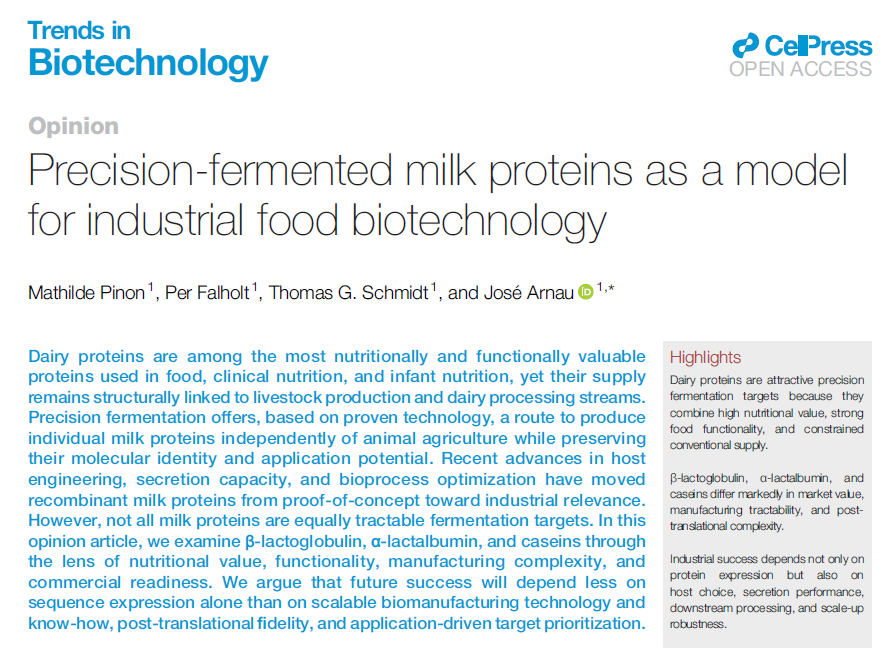
This is what our colleagues explore in the latest article in Cell Press’ Trends in Biotechnology. Mathilde Pinon, Per Falholt, Thomas G. Schmidt and José Arnau looked at precision-fermented milk proteins as a model for what it really takes to turn food biotechnology from promising science into industrial-scale manufacturing.
And one thing becomes clear: not all milk proteins are equally good targets.
💪 Beta-lactoglobulin sits at the sweet spot of nutritional value, functionality, production cost and manufacturing tractability, making it one of the clearest near-term opportunities for precision fermentation.
🍼 Alpha-lactalbumin presents a different opportunity: a highly valuable protein that is naturally scarce, where fermentation could unlock much broader access.
🧀 And then there are the caseins. Caseins could be transformative for applications such as cheese, but reproducing their functionality is a harder engineering challenge. Their performance depends not just on the protein sequence, but on phosphorylation, glycosylation and higher-order assembly.
That moves the central question for industrial biotechnology from “can we produce this protein?” to “can we produce the right protein, with the right molecular properties, at the right quality, scale and cost”?
At 21st.BIO, we believe that the next generation of food biotechnology will be defined not by the proteins we can express, but by those we can produce at industrial scale at high titers with the right functionality.
This is exactly the challenge we are working to solve: building the strains, fermentation and manufacturing capabilities needed to make high-quality precision-fermented milk proteins commercially viable and available in large volumes globally.