

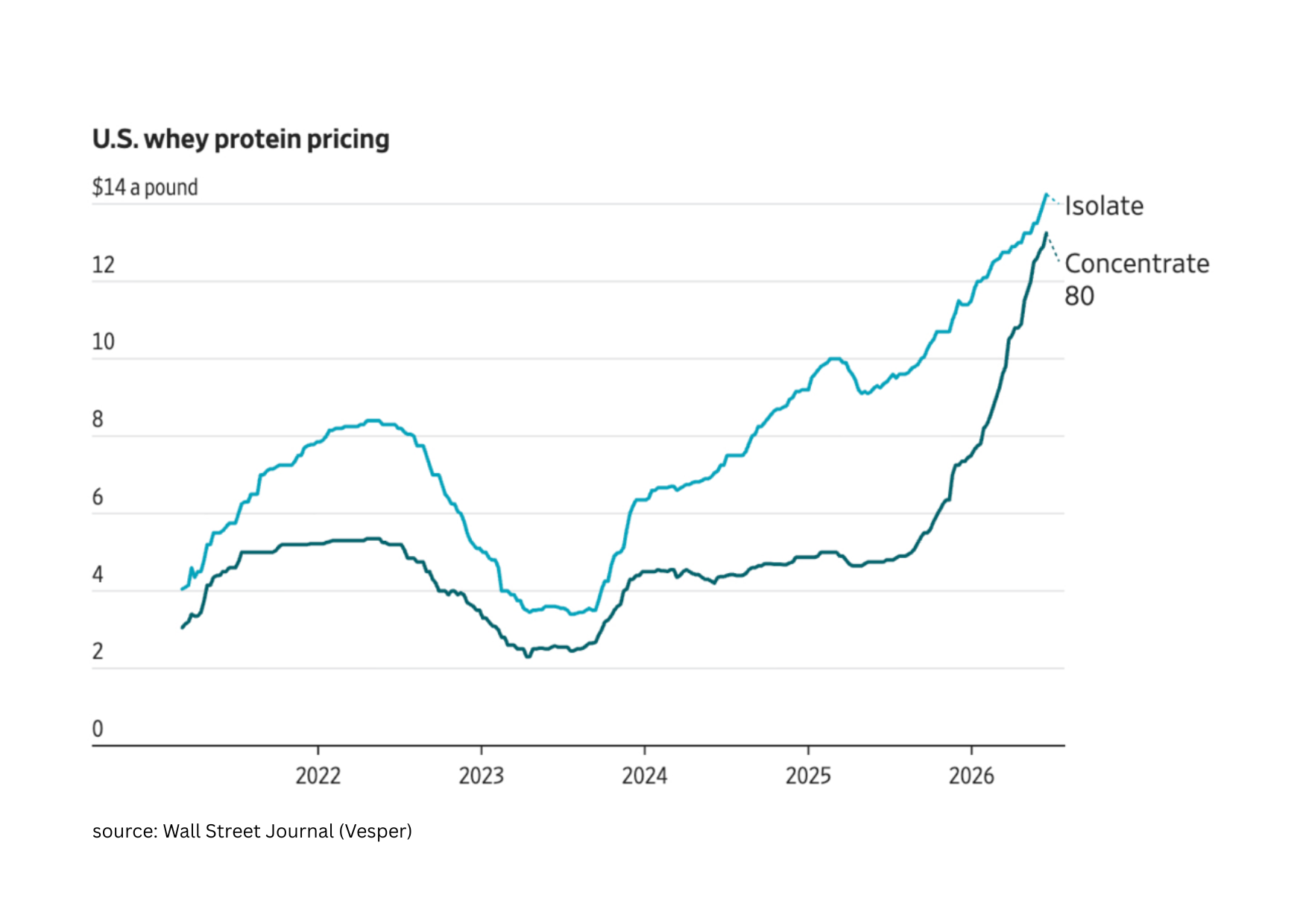
Whey protein isolate prices have climbed to record highs: up roughly 140% in the past two years. Many dairy suppliers have already sold out for 2027. The supply ceiling for conventional whey is no longer a future concern. It’s today’s reality.
At the same time, sugar, precision fermentation’s primary feedstock, has moved in the opposite direction. Global sugar prices have fallen dramatically from their 2023 peak as strong harvests have pushed the market into surplus.
The spread between the product you can make and the cost to make it has never looked so attractive.
Whey’s constraints are structural, not cyclical. It is a cheese byproduct. You cannot scale it independently of milk volumes, processing bottlenecks, and a chain of side streams that each need their own business case.
Even with significant investment, meaningful new dairy processing capacity is still years away. Meanwhile, demand keeps growing.
From high-protein foods to elderly and medical nutrition, and GLP-1-supporting products, the world is asking for more high-quality protein than the conventional dairy system can easily deliver.
Precision fermentation offers a different model: modular production that complements dairy by manufacturing specific proteins such as β-lactoglobulin and α-lactalbumin without relying on milk production or cheese manufacturing.
Precision fermentation has moved from an innovation to an infrastructure story.
With constrained dairy supply, abundant feedstock and growing demand for high-quality protein, the fundamentals are aligning.
For companies looking at where to invest next, this is a moment worth paying attention to.