

For years, cosmetic innovation has been constrained by what nature can provide and what chemistry can synthesize.
But biology is opening up a third path. Precision fermentation goes further than making existing ingredients more sustainably. It expands the ingredient toolbox itself.
Yes, that includes familiar proteins like collagen, elastin, keratin or silk proteins. But that’s only scratching the surface.
Imagine designing bioactive peptides with enhanced stability. Proteins engineered to bind specific skin targets. Novel antimicrobial peptides. Proteins with tailored functionality. Or entirely new ones that have never existed in nature but are designed for a specific cosmetic application.
This is where things get interesting. AI is making remarkable progress in designing de novo proteins with desired functions. But designing a protein is only half the challenge.
Can it actually be expressed? Can it be manufactured at industrial scale? Can it reach the cost and quality needed for commercial success?
A digital protein that can’t be produced remains… a nice theoretic idea. Precision fermentation is the enabling technology.
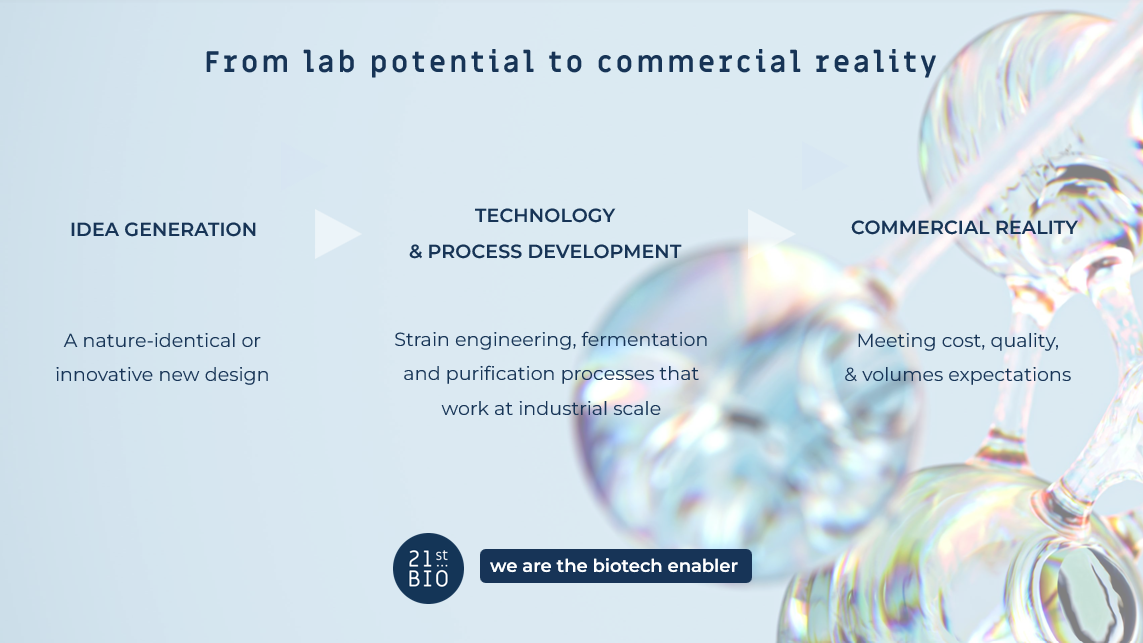
At 21st.BIO, we help companies bridge the gap between protein design and commercial reality. We develop and license precision fermentation technology that enables partners to manufacture proteins and peptides at industrial scale – whether they already exist in nature or are entirely new.
For cosmetics companies, this means thinking beyond replacing existing ingredients. It means asking a different question: If manufacturing biology was no longer the bottleneck, what ingredients would you create?
The next generation of cosmetic innovation may not come from discovering new ingredients in nature. It may come from designing them.